jueves, 21 de febrero de 2013

Solidarity

Homeshare scheme brings comfort to young and old

Beth Cooke, 26, lives with Barbara Clapham, 97, as part of Homeshare, an innovative project that could help tackle the housing crisis
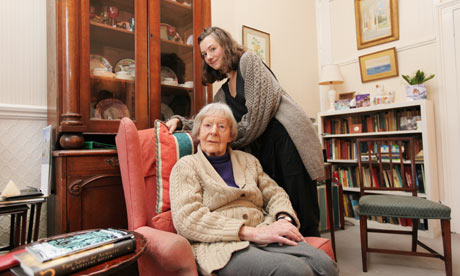

     For the majority of the 53 years Barbara Clapham has lived in her Victorian ground floor flat in an idyllic tree-lined street in central London she has been alone – but now the 97-year-old pensioner has a friend.
     Beth Cooke, 26, has been staying in Clapham's spare room for just two weeks, but already she cooks, washes-up and does the shopping. It is like having the perfect granddaughter to stay, except Cooke's not related and, until a month ago, she'd never met or even heard of Clapham. The odd pairing, bringing together two people seven decades apart in age, came through a scheme called Homeshare.
     The project, organised by a charity called Crossroads, provides affordable housing for young people in central London and companionship and support for elderly people who live on their own.
     Cooke, an actor currently working as a teaching assistant, pays just £50 a week rent for a room two minutes walk from Gloucester Road tube station, which would normally cost as much as £400 a week.
     In return for her bargain-basement rent, Cooke agrees to give up 10 hours each week to help her elderly flatmate.
     "If you want to be in a location like this then it's going to be very, very expensive," says Cooke, who also agrees to spend at least five nights at the flat.
     "I could afford to live in a flatshare in central London, just about. But I wouldn't be able to do it with as much money as I need to do things that I want to do. People are really interested when I tell them about my situation because it is interesting having someone so young living with someone so old. I think you do learn a lot actually, about life, I suppose. I think it's more a feeling of perspective – a completely different perspective, without any kind of family ties."
     Clapham, who owns the property, also pays £32.50 a week to the charity, covering the cost of providing regular support and check-ups on pairings, of which there are about 30.
     "It is difficult going to the shops now; it didn't used to be," explains Clapham, a retired receptionist who worked for the Ministry of Information in Cambridge during the second world war. "For me, it means I can stay here with my own things and not go into a care home. I drove a car until I was 94 but I wasn't happy driving any more, I kept thinking I was going to hit something. It had to go."
     Clapham, who has a niece and nephew living in London, can no longer walk far because of the arthritis in her spine.
"There's a big Sainsbury's across there and it's got a cash machine and I was struggling across the other day and I slipped – so I decided I mustn't do that again," she says. "It's too far now and it's getting more and more difficult for me."
     Clapham has had two previous homesharers, a young Irish girl who "went back to Ireland for the weekend and never came back", and a middle-aged Australian lady who stayed for a year and a half.

Two's company

     Sitting in her cosy living room, with an oil painting of her three-year-old self on the wall, Clapham says she heard about the scheme through a friend who was on it but had to give up because "she's very frail and needs full-time care".
     "I've only got one friend left from my own generation, I'm too old. All my contemporaries have gone, which is boring. So it's nice to have someone around the place, I must say."
     Jenny Bush, who manages Homeshare, describes it as "a bit of a crazy dating service". The charity, which is open to applications all year round, interviews and selects potential homeowners and homesharers before they are introduced to each other and, providing all goes well, are finally "matched".
     The charity is trying to match eight homeowners and homesharers, the youngest of which is 19. In most cases the homeowner provides furniture and an internet connection.
     "In the early stages you do work out what kind of tasks you need doing and make sure the hours are being fulfilled," says Bush, who asks all homesharers to commit to stay for at least six months.
     "The relationship adapts over time. Obviously, you start off and it's very new, like any relationship. Then you get to know each other and find out more and more as time goes on. It's an ongoing issue about high rents in London and also people being isolated in their homes, not being able to get out to do things like the shopping.
     "I think it's really reassuring for family and friends to know if there is someone a little bit older, there is someone there in the evening and overnight."
      Rebecca Manning, 32, a student nurse studying at Middlesex University, has been homesharing with a lady in her 70s in Pinner, north-west London, for the past two months.
     "I think what happens is you become part of the family," she says. "There are obviously boundaries, it's still a professional agreement you have, but she's a bit like my gran, really. I do everything from unloading the dishwasher to popping to the shops to pick up bits and pieces, and having a nice chat with a cup of tea."
Manning missed out on student accommodation – which is becoming increasingly expensive and hard to find – when she moved to London from Suffolk, where she used to be a radio presenter.
     "For her family it provides a bit of peace of mind that she's got someone to stay with," says Manning. "They're all very keen on somebody being there, otherwise they'd have to start thinking about sheltered accommodation. To give up a home which she's lived in for longer than I've been on the planet seems really unfair."
      The scheme was launched and overseen by Kensington and Chelsea borough council in the early 90s, but passed on to Crossroads nearly two years ago.
     Currently Homeshare only operates in certain parts of London, but Bush hopes to expand. There are also a sprinkling of similar schemes across the UK, Europe, Australia, New Zealand, Canada and the US.
"The state isn't going to put people in care homes; they're trying to keep them at home," says Bush. "That's one of the factors in play and that's what we need to address with Homeshare – we really want to make sure it's accessible to a lot more people."
      For Manning, who says she could see herself homesharing for the duration of her three-year degree, the best thing about the scheme is knowing there's someone else in the house. "The first night I moved in I heard a massive noise and I didn't know what it was," she says.
      "So I went downstairs and said, 'you all right?' to the lady I live with and she said, 'I've had a carer live with me for the last two months who has never come down; I really appreciate that you just came down'."

martes, 19 de febrero de 2013

Oral exams different levels

Here you have examples of oral exams related to the levels A1-C2. Remember that the classification A1-C2 is established by the European Union framework, and that each school (e.g. Escuela de Idiomas) or organization (Cambridge, Oxford) creates exams which deal with the contents pointed out in that very framework. I mean, the exams need´t be similar. However, you can have an idea of what you can be required to do. Click here.

lunes, 18 de febrero de 2013

More on brain drain

Brain drain in Spain as 1m graduates swell the ranks of the unemployed

Spain produces more graduates than the European average. But lack of opportunity at home is forcing many to leave


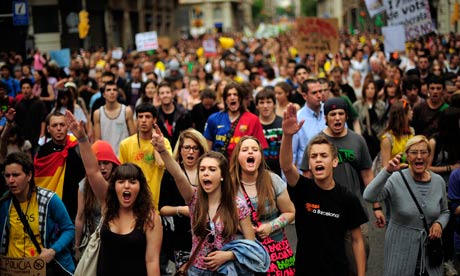
A demonstration by university students in May during national protests against government cuts in education. Photograph: Manu Fernandez/AP

     Virginia Hernández and Quico Iñesta packed their suitcases in 2011, as they stood on the threshold of their 30s. "Ours was a double brain drain," she said over the phone. They left behind family and friends, and a decade of education at publicly funded Spanish universities; with them, they took their knowledge, which they now apply in the rainy city of Dundee, on the east coast of Scotland.
     The doctor and her husband, a biologist, had been among the almost 1 million graduates swelling the ranks of Spain's unemployed, in country that produces an above-average number of graduates (40% of 25- to 34-year-olds against the European Union average of 34%). There is no official figure for how many of those have left since the crisis began, but various estimates put the number at about 300,000. These are the human face of the "unprecedented flight of talent" to which the employment minister, Fátima Báñez, has referred.
     For Hernández, what hurts is the weather. That, and the waste. "It makes no sense to educate us for 11 years and then be unable to offer us anything afterwards," she said. Job security in Scotland and the earnings – £48,000 for her, £32,000 for him – compensate, in part, for the homesickness.
     On the Spanish side of the water, the debate goes on. José Luis Alvarez-Sala, dean of medicine at the Universidad Complutense in Madrid, is clear: "We are producing more doctors than we can absorb." And every year, about 7,000 more qualify in one or other of Spain's 39 universities of medicine. To train a specialist takes between €60,000 (£48,000) and €70,000. But according to the dean, one in four of those graduates leaves the country to look for work.
     "We need to rethink our teaching strategy," he said, "and quantify the real need for specialists." The brain drain, which affects mainly technical careers, has one peculiar aspect in the field of health: at the same time as specialists are leaving, gaps are being filled by professionals from outside the country. "Many recently qualified foreign doctors come here to specialise, and end up staying," Alvarez-Sala added.
     Something similar is happening in nursing. With about 250,000 professionals, Spain suffers from a shortage in the workforce in every one of its regions, according to the country's general council of nursing. Spanish hospitals employed nearly 12,000 foreigners between 2003 and 2007, mainly in the private sector, in which Spaniards see fewer chances of getting an apprenticeship. Meanwhile, 6,000 nurses have left since 2002 in search of job security.
     Raúl Muñoz, in charge of a human resources business in Frankfurt and himself the son of Spanish migrants, said: "They are very sought-after because of their good training and because of the transferability of their qualifications." He has just picked 40 candidates from Madrid, who will move to Frankfurt in the summer after completing an intensive course in German. Some will be back in five years' time, Muñoz said; others will stay abroad permanently.
     Hernández said she would love to come home soon. But she is pregnant, and she fears that no clinic in Spain would offer her work, not even on a daily basis as a locum; in Scotland, they have guaranteed her a year's maternity leave and a renewal of her contract.

viernes, 15 de febrero de 2013

Spanish brain drain


Spaniards: emigrants again


      In Spain, images of emigrants with cardboard suitcases who emigrated to America and Europe in the 1960s in search of a job and a better life are well known.
     This phenomenon was called the “Spanish Diaspora” and ended with the oil crisis in 1973 and as a result of Spain joining the European Union. Spanish emigrants became a thing of the past.
Spain became a country with an enviable standard of living that no longer produced emigrants, but welcomed them.
     Although Spain has never been known for having a low unemployment rate, no one imagined that the current crisis would  result in  5,273,600 unemployed and that  so many of them would be  young people .Youth unemployment now is around 50%,  despite the large number of young people who have emigrated in the last few years.
     According to the Spanish press, around 300,000 trained Spanish youth left the country between 2008 and 2011, discouraged by the lack of jobs. Furthermore, recent labour reforms approved by the new Government, allow small and medium enterprises (SMEs) to fire workers without compensation or cause during the first year of employment. The consequence of these reforms is even more precarious and temporary employment. Young people under 25, because of their lack of experience, may be doomed to work for a very low salary or be trapped in a cycle of unpaid internships. Because of cuts in the research field, researchers have been forced to look for employment abroad and Spain faces a real 'brain drain' that will undoubtedly have a long-term impact in the country, socially and economically.
     Although this phenomenon has been happening for many years, it has only recently been talked about and considered a problem. This may be because young Spanish people no longer migrate only to Northern European countries, known for their high standard of living, but are also beginning to migrate to Eastern European countries. The Czech newspaper Lidové Noviny, in a recent article, talks of the large increase in the number of young immigrants from Southern Europe to Eastern Europe.
     The question is how long it will last? Most young people see it as a temporary situation. They are thinking about working abroad for a few years until “the crisis is over”, or at least until the worst of it is over, and then to come home and find work. However, what awaits them? Some theories claim that the crisis will be followed for a long period of depression that will last for years, during which there will be no significant changes to the unemployment rate, and even then, things will never be good as before. Many of these young people have grown up in families with a standard of living that they themselves will not be able to attain.
     Meanwhile, in Spain the Government continues making cuts and young people are leaving in large numbers. Are young Spanish people doomed to unemployment? Time will tell.

Young people and politics


The Guardian home


    There's a broad consensus that young people like me aren't interested in politics, which is flatly contradicted by recent protests. This week 130,000 students, sixth-formers and schoolchildren walked out of classes and lectures and took to the streets across the country. The government sought to portray those who took part in the recent protest at Millbank as a small faction of leftwing extremists and in turn undermine the entire day's protest. However, it's not so easy to write off thousands of schoolchildren worried about their future.
     Young people are angry and this frustration is unquestionably political. However, it has no natural outlet in our politics. In the last general election, young people between the ages of 18 and 25 were more likely to become first-time abstainers than first-time voters. Only 37% of 18-24-year-olds voted in the 2005 general election. Most significant of all, 76% of young people didn't feel they could "influence government decisions".
It's not surprising that an overwhelming majority of us don't trust politicians. Many have chastised the Liberal Democrats for their U-turn on fees. But in the last few months, we have seen promises made and broken by all three major political parties. Nick Clegg's about-face is not an exception; it is par for the political course. With a national political debate like this, it's not surprising our disenchantment has become mistaken for apathy. It's not that young people are not interested in politics – politics isn't interested in us.
     Recent research shows that the majority of young people have signed petitions or attended demonstrations in support of local campaigns to protect leisure facilities, prevent hospital closures or improve funding for further and higher education. However, they rarely recognised these actions as "political". What this shows is that for young people to become engaged with politics, it is politics that needs to change. But where to start?
     First of all, lower the voting age to 16. At 16 you can join the army, get a job, pay taxes, get married, start a family. But you can't vote. Stopping 16- and 17-year-olds from voting sends a clear signal: "Your views aren't valid and you aren't real citizens." In order to make politics relevant we should be doing everything we can to encourage young people to engage.
   Second, we need more imaginative and entertaining political education in schools and colleges – and I don't mean only introducing it as a pre-GCSE subject. Pupils should have an active role in decision making in schools through democratically elected representatives, as well as the opportunity to directly influence councils and local authorities through pupil-run campaigns. This would engender the importance of the democratic process and ensure that they understand they are stakeholders in both their education and their country. Whether it's a "core subject" or not, a concept of citizenship should be woven into the fabric of a pupils' education.
     Third, politicians need to make more effort to consult young people and understand their concerns. Yes, this is a two-way street. If young people vote, politicians will listen. But any number of progressive politicians will heed the call of an energised youth vote. The average age for an MP in Britain is 50. If our political class reflects a wider cross-section of the population in terms of age, sex, ethnic origin and social class, then we will have made a start.
     When it comes to youth issues, political will is shockingly sparse. Work on engaging young people in politics should be seen as an investment in the future of democracy – an investment in its legitimacy, relevance and engagement among the future adult population.
     If no natural outlet is found in our politics for the frustration that is growing among the young, then politicians are at risk of disenfranchising an entire generation. They may never again have the opportunity persuade us that voting, democracy and the parliamentary process matter.

Young people and migration

As you know, because of the economic crisis we are going trhough many young people are migrating to other countries like Germany, England or even outside of Europe. This is not new. The 1960s were a period of migration to!