If you don´t practice your English, you can end up speaking like these people!
martes, 26 de febrero de 2013

Global Issues: the use of coltan and its consequences
 Global Issues
The demand for cell phones and computer chips is helping fuel a bloody civil war in the Democratic Republic of Congo.
 The offer turned up a few weeks ago on an Internet bulletin board called the Embassy Network. Among the postings about Dutch work visas and Italian pen pals lurked a surprisingly blunt proposal: "How much do you want to offer per kilogram? Please find me at least 100,000 U.S. dollars and I will deliver immediately."
The substance for sale wasn't cocaine or top-grade opium. It was an ore called Columbite-tantalite - coltan for short - one of the world's most sought-after materials. Refine coltan and you get a highly heat-resistant metal powder called tantalum. It sells for $100 a pound, and it's becoming increasingly vital to modern life. For the high-tech industry, tantalum is magic dust, a key component in everything from mobile phones made by Nokia (NOK) and Ericsson and computer chips from Intel (INTC) to Sony (SNE) stereos and VCRs.
Selling coltan is not illegal. Most of the worldwide tantalum supply - valued at as much as $6 billion a year - comes from legitimate mining operations in Australia, Canada and Brazil. But as demand for tantalum took off with the boom of high-tech products in recent years, a new, more sinister market began flourishing in the Democratic Republic of Congo. There, warring rebel groups - many funded and supplied by neighboring Rwanda and Uganda - are exploiting coltan mining to help finance a bloody civil war now in its third year. "There is a direct link between human rights abuses and the exploitation of resources in areas in the DRC occupied by Rwanda and Uganda," says Suliman Baldo, a senior researcher in the Africa division at Human Rights Watch, a New York-based nongovernmental organization that tracks human-rights abuses worldwide.
The slaughter and misery in the Congo has not abated since the country's president, Laurent Kabila, was assassinated in January. (Kabila's son, Joseph, was quickly appointed the new head of state.) Human Rights Watch researchers, working with monitors in the Congo, estimate that at least 10,000 civilians have been killed and 200,000 people have been displaced in northeastern Congo since June 1999. Rebels have driven farmers off their coltan-rich land and attacked villages in a civil war raging, in part, over control of strategic mining areas. The Ugandan and Rwandan rebels "are just helping themselves," Baldo says. The mining by the rebels is also causing environmental destruction. In particular, endangered gorilla populations are being massacred or driven out of their natural habitat as the miners illegally plunder the ore-rich lands of the Congo's protected national parks.
The link between the bloodshed and coltan is causing alarm among high-tech manufacturers. Slowly they are beginning to grapple with the possibility that their products may contain the tainted fruits of civil war. A similar controversy, after all, wracked the diamond industry in the late 1990s, when global demand for the gems helped finance civil wars in Sierra Leone, Angola and Liberia. Since then, the international community has clamped down on the diamond trade, imposing tougher import and export regulations.
But with tantalum, such regulations may be difficult to enforce. The market for the metal is based on secretive and convoluted trade links subject to few international regulations, and the ore is not sold on regulated metals exchanges.
lunes, 25 de febrero de 2013
Afternoon extra class put off
Todayś afternoon class will be put off till next Monday due to teacherś meeting. See you (all) tomorrow. Hope you have studied hard for the exam!
viernes, 22 de febrero de 2013
Ageing
An age-old problem 

It will be hard to reconcile increased longevity with public spending cuts

GROWING old may be preferable to the alternative but it is not without its problems: greying Britain will have increasing numbers of elderly, needy people to look after. On gaining power last year, the coalition government set up an independent commission to identify how to make long-term care affordable. Just as the commission is due to report, the problems it set out to solve are becoming more acute: another official body has called for the aged and frail to be given new rights to receive help, and cuts in central-government funding are forcing local councils to reduce the services they already provide.
Earlier this month the Law Commission, which helps Parliament tidy up legislation, recommended that councils be given wide-ranging new obligations to provide care to vulnerable adults, replacing the current, patchy set of entitlements. Fine in principle, but where will the money come from? A survey by the Association of Directors of Adult Social Services, published the following day, showed that councils in England intend to cut spending on adult social care by 7% this year, although they hoped to achieve much of that reduction in outlays through efficiency measures rather than service cuts.
The Law Commission report adds urgency to the quest for new ways to pay for care. At the moment, if a doddery old man is poor and has no family or friends to help out, the state will provide help at home free of charge; but if he has the means, he must pay for it himself. Should his health deteriorate to the point where he can no longer make a cup of tea, he will be encouraged into residential care. Again, if he is poor, it is free; if he is not, he must run down his savings and sell his home.
Most Britons would find it a wrench to give up the home they spent much of their working lives paying for. Indeed, in the run-up to last year's election the Conservatives provoked a frightful row when they exploited such fears by portraying Gordon Brown's suggestion that long-term care could be paid for from the estates of wealthy recipients as a “death tax”. So the independent commission, headed by Andrew Dilnot, an economist at the University of Oxford, was asked to identify how people who had acted responsibly, saved money and bought property might be protected from financial ruin should they need expensive long-term care.
His report is likely to suggest some sort of insurance scheme. At present only a small proportion of people take out such policies: 7% in America, 5% in Japan and less than 0.05% in Britain, according to the OECD, a think-tank. To boost take-up, the state would probably have to underwrite any new scheme.
Insurance is not the only solution. The Joseph Rowntree Foundation, a charity, reckons that around 1m elderly homeowners have at least £100,000 locked up in the value of their houses, but have incomes so low that they qualify for means-tested benefits and are struggling to get by. It has piloted a scheme with three local authorities in which such people—typically former tenants who bought their council-owned houses decades ago—can sell a stake in them (which the buyers would reclaim after their death) to pay for modifications, such as a walk-in shower, that would help them remain in their homes rather than go into a care home.
Take-up has been modest so far, says Clare Henderson of Islington Council in north London, which is participating in the pilot project. She expects demand to grow as people develop more confidence in such schemes. However, pensioners may take some convincing, given the widespread mis-selling of similar “home income plans” to elderly people in the 1980s.
With the proportion of Britons aged over 65 projected to grow from 16% in 2009 to 23% by 2034, the need to find alternatives to taxpayer funding for social care will only grow. On May 23rd the OECD said that if health, pensions and social care were to keep pace with current provision, spending on them would have to increase from 15% of GDP to almost 19% between 2010 and 2050. Worry enough to turn any politician's hair grey.
jueves, 21 de febrero de 2013
Solidarity
Homeshare scheme brings comfort to young and old
Beth Cooke, 26, lives with Barbara Clapham, 97, as part of Homeshare, an innovative project that could help tackle the housing crisis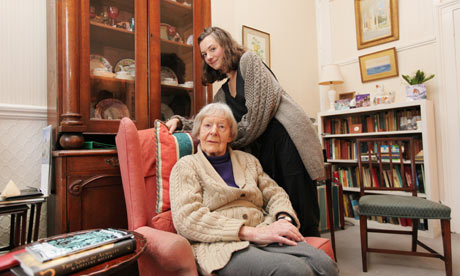
For the majority of the 53 years Barbara Clapham has lived in her Victorian ground floor flat in an idyllic tree-lined street in central London she has been alone – but now the 97-year-old pensioner has a friend.
Beth Cooke, 26, has been staying in Clapham's spare room for just two weeks, but already she cooks, washes-up and does the shopping. It is like having the perfect granddaughter to stay, except Cooke's not related and, until a month ago, she'd never met or even heard of Clapham. The odd pairing, bringing together two people seven decades apart in age, came through a scheme called Homeshare.
The project, organised by a charity called Crossroads, provides affordable housing for young people in central London and companionship and support for elderly people who live on their own.
Cooke, an actor currently working as a teaching assistant, pays just £50 a week rent for a room two minutes walk from Gloucester Road tube station, which would normally cost as much as £400 a week.
In return for her bargain-basement rent, Cooke agrees to give up 10 hours each week to help her elderly flatmate.
"If you want to be in a location like this then it's going to be very, very expensive," says Cooke, who also agrees to spend at least five nights at the flat.
"I could afford to live in a flatshare in central London, just about. But I wouldn't be able to do it with as much money as I need to do things that I want to do. People are really interested when I tell them about my situation because it is interesting having someone so young living with someone so old. I think you do learn a lot actually, about life, I suppose. I think it's more a feeling of perspective – a completely different perspective, without any kind of family ties."
Clapham, who owns the property, also pays £32.50 a week to the charity, covering the cost of providing regular support and check-ups on pairings, of which there are about 30.
"It is difficult going to the shops now; it didn't used to be," explains Clapham, a retired receptionist who worked for the Ministry of Information in Cambridge during the second world war. "For me, it means I can stay here with my own things and not go into a care home. I drove a car until I was 94 but I wasn't happy driving any more, I kept thinking I was going to hit something. It had to go."
Clapham, who has a niece and nephew living in London, can no longer walk far because of the arthritis in her spine.
"There's a big Sainsbury's across there and it's got a cash machine and I was struggling across the other day and I slipped – so I decided I mustn't do that again," she says. "It's too far now and it's getting more and more difficult for me."
Clapham has had two previous homesharers, a young Irish girl who "went back to Ireland for the weekend and never came back", and a middle-aged Australian lady who stayed for a year and a half.
Two's company
Sitting in her cosy living room, with an oil painting of her three-year-old self on the wall, Clapham says she heard about the scheme through a friend who was on it but had to give up because "she's very frail and needs full-time care".
"I've only got one friend left from my own generation, I'm too old. All my contemporaries have gone, which is boring. So it's nice to have someone around the place, I must say."
Jenny Bush, who manages Homeshare, describes it as "a bit of a crazy dating service". The charity, which is open to applications all year round, interviews and selects potential homeowners and homesharers before they are introduced to each other and, providing all goes well, are finally "matched".
The charity is trying to match eight homeowners and homesharers, the youngest of which is 19. In most cases the homeowner provides furniture and an internet connection.
"In the early stages you do work out what kind of tasks you need doing and make sure the hours are being fulfilled," says Bush, who asks all homesharers to commit to stay for at least six months.
"The relationship adapts over time. Obviously, you start off and it's very new, like any relationship. Then you get to know each other and find out more and more as time goes on. It's an ongoing issue about high rents in London and also people being isolated in their homes, not being able to get out to do things like the shopping.
"I think it's really reassuring for family and friends to know if there is someone a little bit older, there is someone there in the evening and overnight."
Rebecca Manning, 32, a student nurse studying at Middlesex University, has been homesharing with a lady in her 70s in Pinner, north-west London, for the past two months.
"I think what happens is you become part of the family," she says. "There are obviously boundaries, it's still a professional agreement you have, but she's a bit like my gran, really. I do everything from unloading the dishwasher to popping to the shops to pick up bits and pieces, and having a nice chat with a cup of tea."
Manning missed out on student accommodation – which is becoming increasingly expensive and hard to find – when she moved to London from Suffolk, where she used to be a radio presenter.
"For her family it provides a bit of peace of mind that she's got someone to stay with," says Manning. "They're all very keen on somebody being there, otherwise they'd have to start thinking about sheltered accommodation. To give up a home which she's lived in for longer than I've been on the planet seems really unfair."
The scheme was launched and overseen by Kensington and Chelsea borough council in the early 90s, but passed on to Crossroads nearly two years ago.
Currently Homeshare only operates in certain parts of London, but Bush hopes to expand. There are also a sprinkling of similar schemes across the UK, Europe, Australia, New Zealand, Canada and the US.
"The state isn't going to put people in care homes; they're trying to keep them at home," says Bush. "That's one of the factors in play and that's what we need to address with Homeshare – we really want to make sure it's accessible to a lot more people."
For Manning, who says she could see herself homesharing for the duration of her three-year degree, the best thing about the scheme is knowing there's someone else in the house. "The first night I moved in I heard a massive noise and I didn't know what it was," she says.
"So I went downstairs and said, 'you all right?' to the lady I live with and she said, 'I've had a carer live with me for the last two months who has never come down; I really appreciate that you just came down'."
martes, 19 de febrero de 2013
Oral exams different levels
Here you have examples of oral exams related to the levels A1-C2. Remember that the classification A1-C2 is established by the European Union framework, and that each school (e.g. Escuela de Idiomas) or organization (Cambridge, Oxford) creates exams which deal with the contents pointed out in that very framework. I mean, the exams need´t be similar. However, you can have an idea of what you can be required to do. Click here.
Suscribirse a:
Entradas (Atom)